The Cost-Per-Use Routine Planner
Price your skincare routine by what each step really costs: the amount you use, measured once; the uses your routine runs; each jar stopped at its open-jar date; and a year's budget built from that instead of a guess
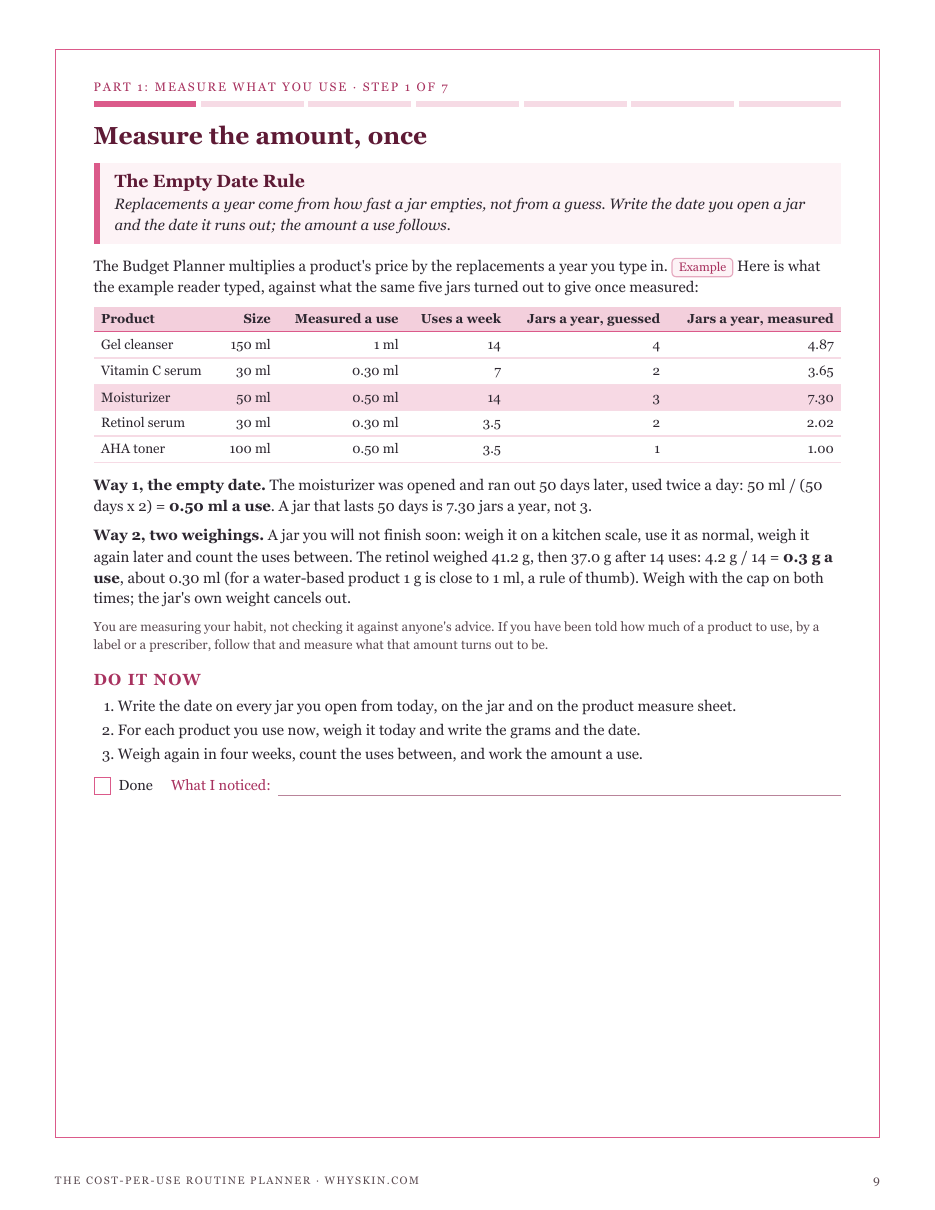
WhySkin's Beauty Budget Planner multiplies each product's price by the replacements a year you type in, and it even starts you off with three moisturizers a year. The arithmetic is right; the input is a guess. A product used morning and night empties twice as fast as one used once a day, an alternate-night treatment half as fast again, and a slow jar can reach its maker's open-jar date before it is empty, so a single guessed count is rarely right for a whole shelf. The Cost-Per-Use Routine Planner measures it instead. In its worked example, the routine WhySkin's Routine Builder gives for normal skin with fine lines and dark spots (a cleanser and a moisturizer morning and night, a vitamin C serum, and a retinoid and an AHA on alternate nights) is $215.46 a year as guessed and $346.35 once measured, 61% more; the 50 ml moisturizer alone empties in 50 days, 7.3 jars a year rather than 3. The plan works the cost of each use, which bottle size is the bargain at your habit (a 50 ml retinol used on alternate nights costs 36% more a use than the 30 ml, because both reach their 6-month date after 90 uses), and a restock calendar for the year. Every figure is computed by the code WhySkin's Budget Planner, Routine Builder and Expiry Date Tracker run, and the products, prices and amounts are examples, tagged as such. It prices products and says nothing about what they do for skin; use-by dates are always the maker's; it does not cover sunscreen. Inside: seven steps, four working pages (product measure sheet, cost-per-use sheet, real budget sheet, restock calendar), a jar-life table and a quickstart, plus a personalised sheet worked from the numbers you entered in the calculator.
Look inside
Two full pages from the plan, exactly as printed. Click either to read it at full size before you decide.
What is in it
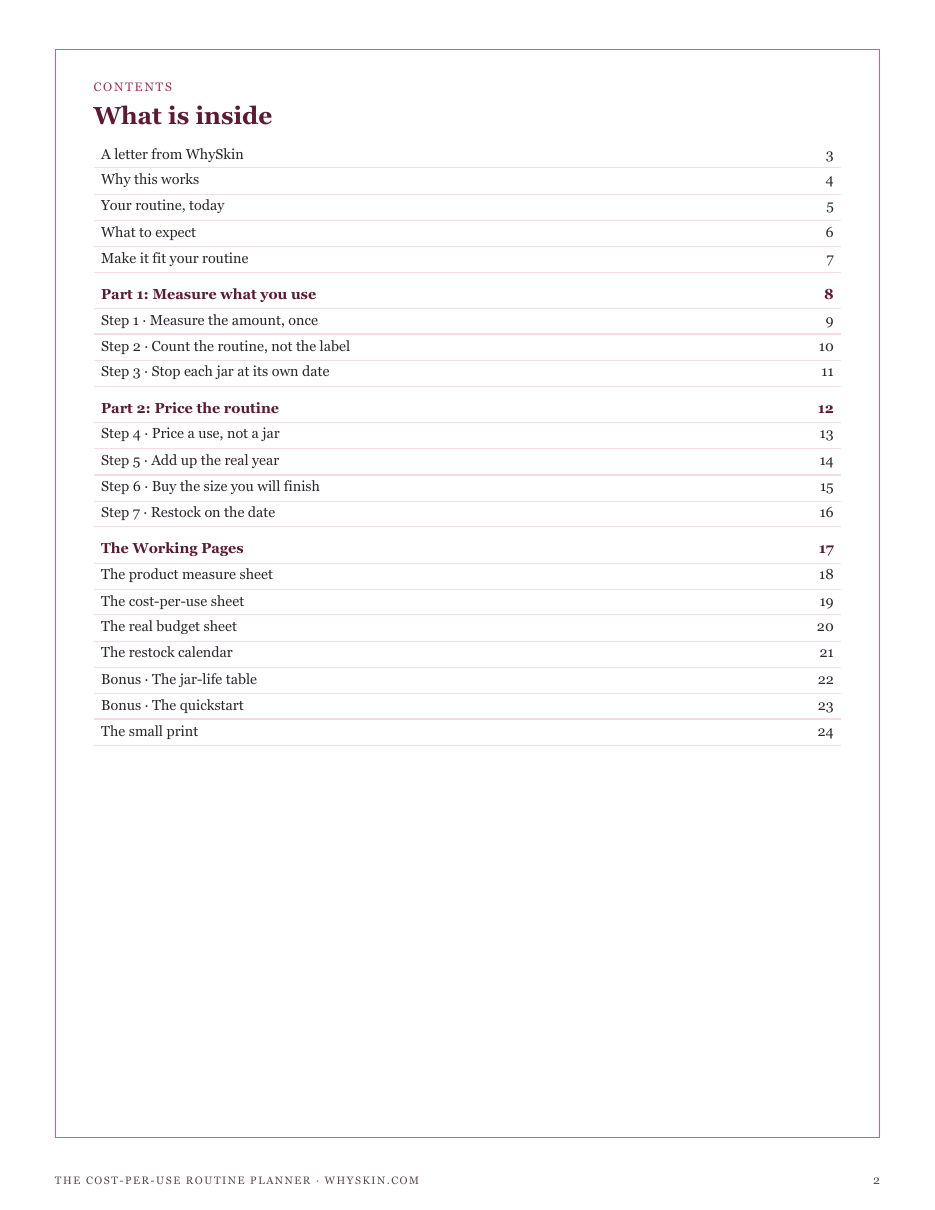
- Step 1: the amount you use, measured once, from the dates on a jar that runs out or two weighings four weeks apart
- Step 2: uses a week counted from your routine, morning and night at 14, alternate nights at 3.5
- Step 3: each jar stopped at the maker's open-jar date, counted the short way, and what is left at the date
- Step 4: the cost of each use and of each week, and where the money actually goes
- Step 5: the real year, with the Budget Planner fed measured jars in place of guesses
- Step 6: the size check: which bottle size is cheaper a use at your own habit, and where the bigger one starts to win
- Step 7: a restock calendar for the year, and when a backup is worth buying
- Four working pages: a product measure sheet, a cost-per-use sheet, a real budget sheet and a restock calendar
- A jar-life table for six sizes and seven habits at 12M and 6M open-jar dates, and a quickstart that closes the score loop
- A personalised sheet: what your Budget Planner guesses say each jar must last, your routine's uses a week, and your jar's open-jar cap
- ✓ 24 printable pages
- ✓ 10 sections, worksheets and templates
- ✓ A second PDF worked out from the numbers you enter
- ✓ No account needed, just an email address
- ✓ Instant download; link valid 7 days
Price includes any taxes. Sold by GrabURL, who handle checkout and support. The charge appears on your statement as GrabURL.
The planner picks up where the free Beauty Budget Plannerleaves off. The budget planner multiplies each product’s price by the replacements a year you type in, and that number is usually a guess. The planner measures it instead: how much of each product you use, from an empty jar or two weighings; how many uses a week your routine runs, straight from the Skincare Routine Builder; and the maker’s open-jar date that ends every jar, as the Expiry Date Tracker counts it. From those it works the cost of each use, the real year, which bottle size is the bargain, and a restock calendar. It prices products; it says nothing about what they do for skin, and it does not cover sunscreen. Every figure in it is an example for you to replace.